



In the landscape of startup acceleration, Y Combinator (YC) has long been a dominant force in the “launch fast and iterate” model. But in a market flooded with B2B SaaS, one of YC’s recent Request for Startups (RFS) signals a major, deliberate shift.
Diana Hu at YC is particularly interested in hard tech. She is known for her conviction that the real opportunity is in using AI to solve fundamental problems in the physical world. She isn’t just predicting improvement; she’s identifying a new area for high-risk, massive-reward investing.
TL;DR
From SaaS to Science: YC’s RFS, championed by Hu, signals a major appetite shift toward hard tech. They are specifically looking for LLMs to be applied to hard sciences, such as discovering drugs or new materials, not just writing emails.
The Infrastructure Bottleneck: A second thesis, co-authored with Dalton Caldwell, targets the “single biggest bottleneck in the current AI boom: physical infrastructure.”
The “Lights Out” Datacenter: The bet is on non-software innovation. The ask is for “’lights out’ autonomous datacenters managed by robots and software”, a bet on “concrete and electricity, not just code.”
Challenging the YC Model: These theses represent a move toward “high-risk, massive-reward investing” with “very long feedback loops” (e.g., FDA approval), which directly challenges the traditional YC model of “launch fast and iterate.”
The Capital Hurdle: This new focus raises questions about capital, asking if a startup can realistically compete with hyperscalers if traditional early-stage raise amounts do not significantly change.
The Platform: Y Combinator
The Firm’s Identity: Y Combinator (YC) is a highly successful startup accelerator, built on a philosophy of rapid iteration and scaling. Its traditional model, “launch fast and iterate”, has defined a generation of software-first companies.
The Overarching Philosophy: YC’s core philosophy is expressed through its intensive batch program and its widely read Request for Startups (RFS). This RFS acts as a powerful signal to founders, directing entrepreneurial energy toward problems YC believes are most critical. While historically focused on software, the firm’s philosophy is evolving to support new categories of innovation.
Alignment: Diana Hu’s work aligns directly with YC’s new strategic mandate. As a champion of the “AI for Scientific Advancement” RFS, her focus is not a side project; it is a direct execution of the firm’s strategic shift. This new focus on hard tech and deep domain expertise aligns YC’s platform with a new class of high-risk, high-reward founders.
The Navigator: Diana Hu
The Journey to the Thesis: Diana Hu’s perspective is not that of a traditional investor; it’s that of a deep tech operator and founder. Her journey was forged by a “geeky learning obsession”, leading her to an MS in Electrical and Computer Engineering from Carnegie Mellon with a focus on computer vision and machine learning.
Her path wasn’t a straight line to VC. She was an operator at Intel and OnCue TV (sold to Verizon). The pull to build led her to co-found and serve as CTO of Escher Reality (YC S17), an AR backend company. This YC founder experience gave her deep operator empathy.
After Niantic acquired Escher Reality, she led their AR platform as Director of Engineering. Her return to YC as a Group Partner completes the cycle, as she is now a technical founder guiding the next generation of hard tech.
The “Why”: Hu’s drive is her constant curiosity to learn” She sees her work not just as investing, but as an “outlet of my exploration and curiosity”. She views technologies like AR, and by extension the hard tech in her RFS, as the “next technology evolution” after desktop and mobile. As an immigrant founder herself, her “why” is deeply connected to helping other founders navigate the high-stakes, technically complex journey she has already completed.
Investment Philosophy: Hu’s philosophy is founder-focused and expertise-driven. Having been a technical CTO and YC founder, she invests “in places where I feel I can truly contribute and be helpful to founders.”
She is not a generalist. She focuses on spaces where she has deep expertise, such as “computer vision, machine learning or VR,” which perfectly mirrors her “AI for Science” and “Autonomous Datacenter” theses. She views investing as a long-term journey and looks for founders with a growth-oriented mindset whom she will be “happy to continuously support.”
The Core: Deep Dive into Investment Theses
This is where we explore the high-conviction ideas shaping YC’s updated worldview. Two key theses emerge: the reorganization of scientific discovery by AI and the robotic future of the datacenters that power it.
Thesis 1: AI for Scientific Advancement
The “What” (The Opportunity): This thesis moves beyond generic AI hype to target hard sciences. Hu is “specifically looking for LLMs applied to discover drugs or new materials”. This is a deliberate “move toward high-risk, massive-reward investing.”
The “Why Now” (The Rationale): The thesis taps into the current excitement around AlphaFold and similar breakthroughs, suggesting that AI is finally mature enough to tackle fundamental biology and physics problems.
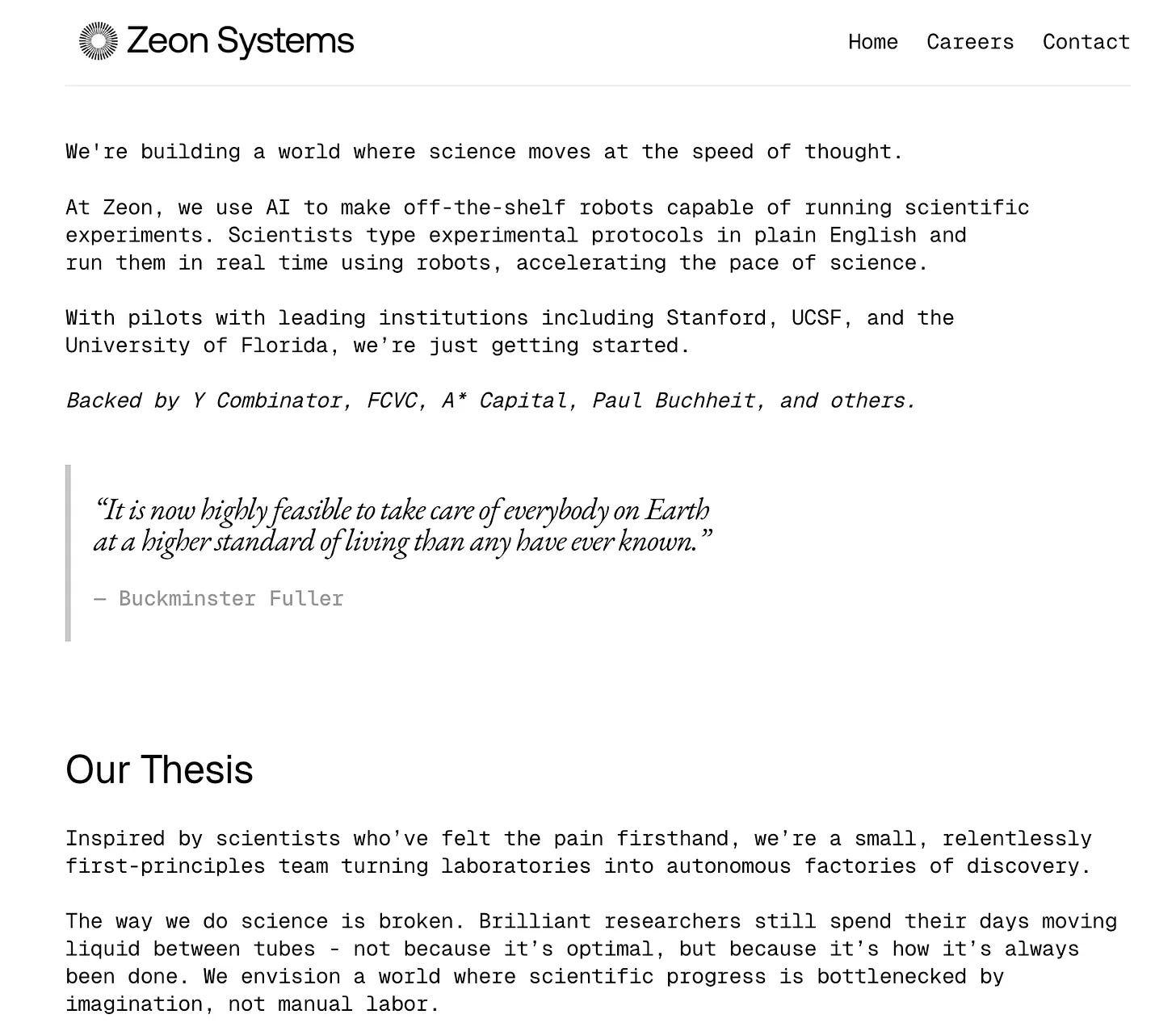
The “Winning Profile” (What They Look For): This thesis requires founders with deep domain expertise. A prime example from the current YC batch is Zeon Systems, a company that lets you describe an experiment in plain text which its robot arms then execute. The bet is that this approach could “drop [the price of scientific research] 90%.”
The “Conversation” (Nuance and Debate): This bold thesis brings up critical challenge questions:
The YC Model Challenge: “Scientific advancement historically has very long feedback loops (e.g., FDA approval)”. How does this mesh with the traditional YC model of “launch fast and iterate?”
The Tool Mismatch Challenge: Are LLMs actually the right tool for all scientific advancement, or is this “forcing a language paradigm onto hard physics/bio problems that need different architectures?”
Thesis 2: Rethinking Datacenters with Software and Robotics
The “What” (The Opportunity): This thesis, co-authored with Dalton Caldwell, “addresses the single biggest bottleneck in the current AI boom: physical infrastructure.” It is a “very ‘non-software’ software thesis.” YC is not just asking for better management tools; they are “asking for ‘lights out’ autonomous datacenters managed by robots and software.”
The “Why Now” (The Rationale): The thesis is anchored by the fact that “energy and space constraints begin to hit major AI players.” It’s a “bet that the sheer demand for compute will force innovation in concrete and electricity, not just code.”
The “Conversation” (Nuance and Debate): This strategy surfaces two critical VC questions:
The Hyperscaler Challenge: Can a startup realistically compete in datacenter innovation when giants like Google, Amazon, and Microsoft are spending tens of billions annually on this exact problem?
The Capital Challenge: Is this a capital-intensive play that requires far more than the traditional early-stage checks to get off the ground?
The Bottom Line
Diana Hu’s investment theses provide insight into YC’s evolution. While much of the market remains focused on iterating SaaS, her RFS focus remains clearly on deep domain expertise and hard tech.
Her bets on AI for Science and autonomous datacenters demonstrate a conviction that the next wave of value won’t come from novelty, but from the hard work of integrating AI into real-world, physical workflows. It’s a pragmatic, accelerator-first perspective that sees AI not just as a tool for writing emails, but as a tool of discovery.
More from Uncovered Media

