



Founders Fund’s Trae Stephens sees a future shaped not just by software, but by industrial-scale, mission-driven manufacturing. In a market where many venture capitalists chase consumer AI and crypto, Trae has become the definitive voice for a philosophy that is deliberately contrarian, philosophically robust, and deeply intertwined with national security: technology that is necessary, even if it is unpopular.
Trae’s career, from the US Intelligence Community to Palantir, and co-founding the defense behemoth Anduril Industries, gives him a unique lens on the nexus of technology, geopolitics, and capital. For him, the biggest opportunity for founders is not to avoid the messiness of hard, physical problems, but to embrace them.
TL;DR
The Factory is the Weapon: In modern geopolitical competition, the ability to rapidly and scalably manufacture software-defined hardware (like autonomous drones and aircraft) is the ultimate form of deterrence. This re-industrialization is a strategic necessity, making large, verticalized production facilities (like Anduril’s Arsenal-1 megafactory) a critical investment for national security.
Reject the Dual-Use Mandate: The requirement that defense technology must have a parallel commercial application hinders innovation. Founders should instead focus laser-like on building the best possible, defense-specific solutions, even if the government is the sole customer. Founders Fund is willing to stomach the single-buyer risk because the payoff—becoming the next major defense prime—is worth it.
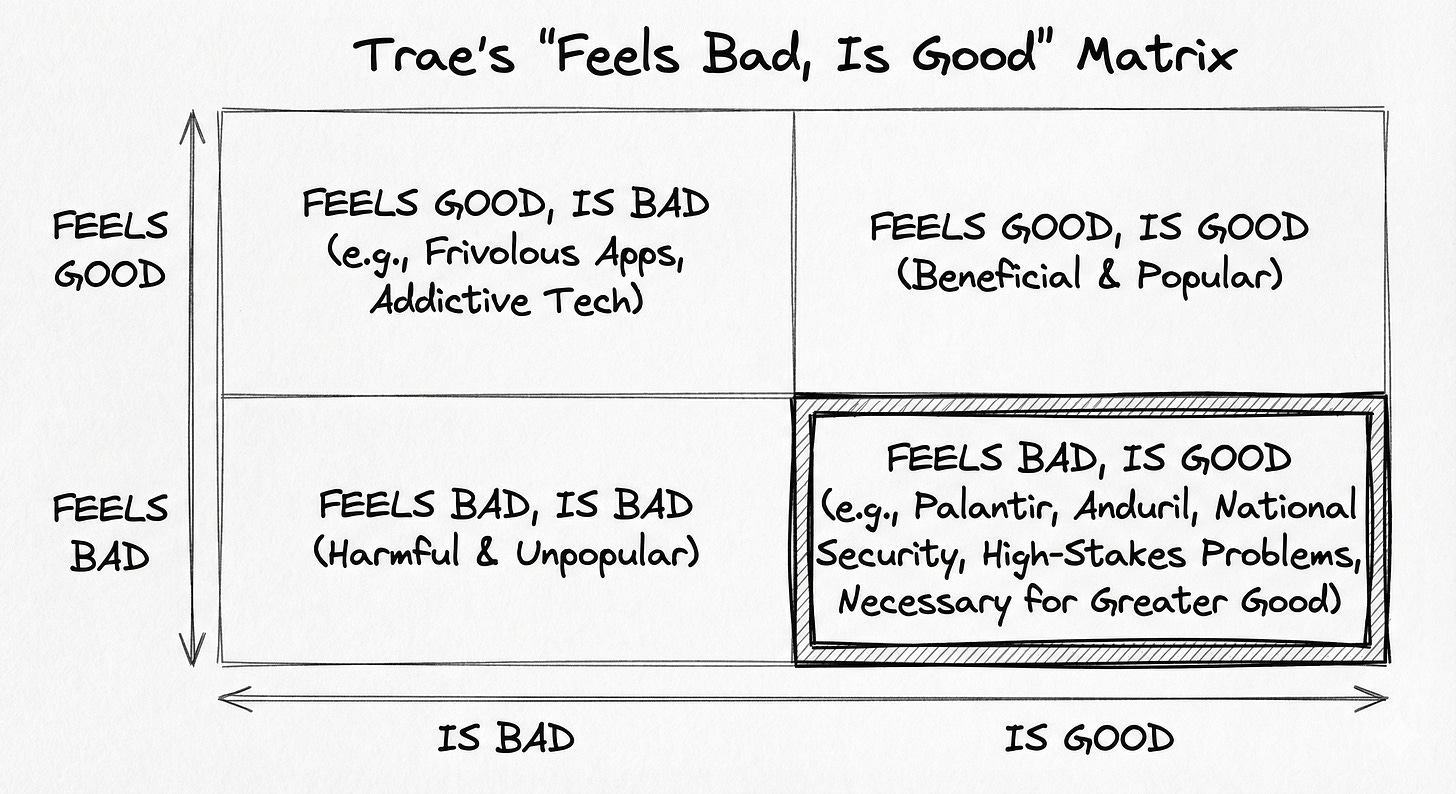
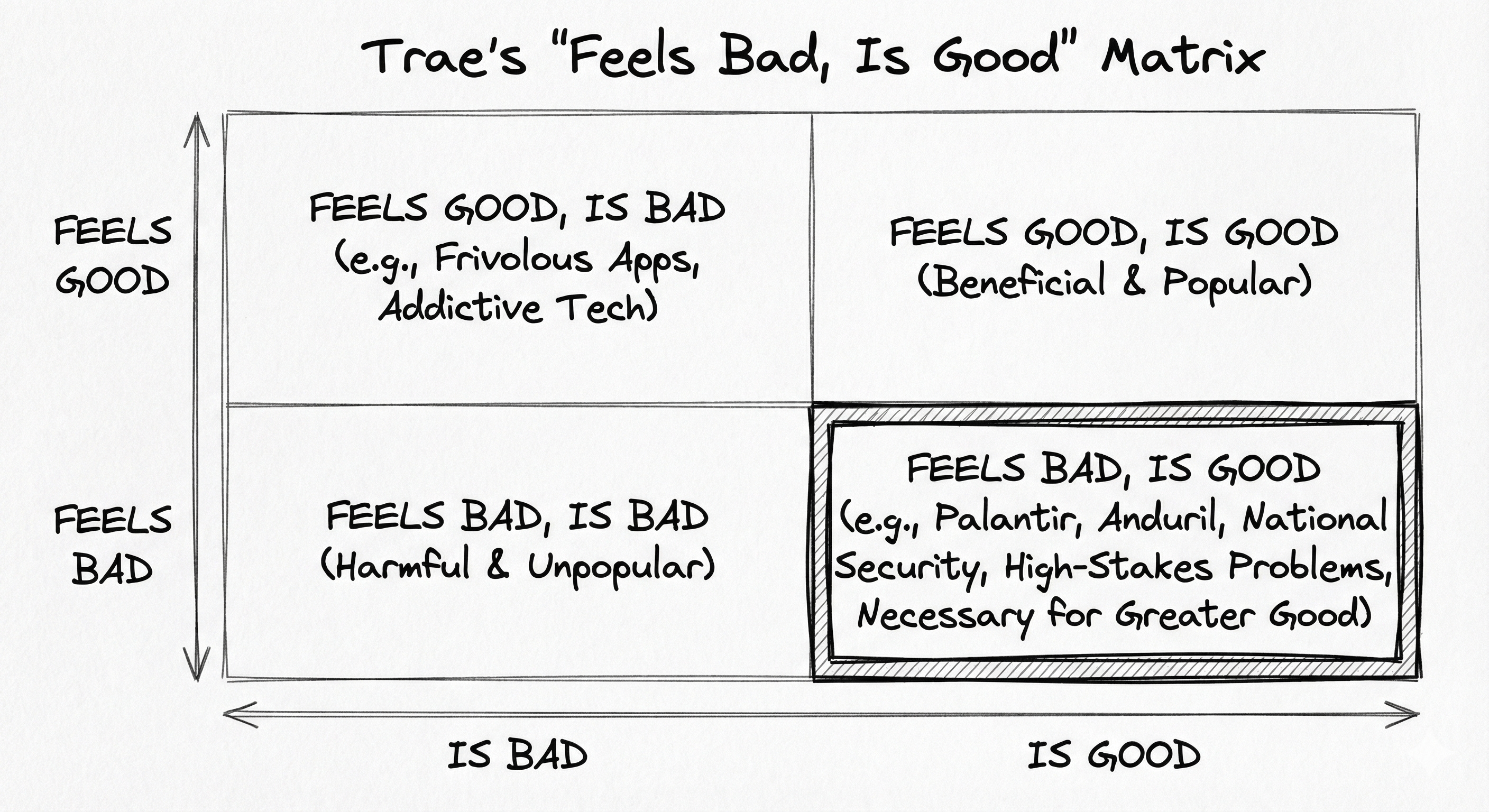
The “Feels Bad, Is Good” Quadrant: Trae explains that the most valuable, contrarian ventures often reside in this 2x2 framework (Feels Good/Bad versus Is Good/Bad), embracing missions that may provoke public or ethical discomfort (e.g., defense, mass surveillance) but whose technological success is necessary for a greater, often overlooked, good. It is a call for founders to embrace high-stakes, ethically complex problems.
Founders Fund
Founders Fund is one of Silicon Valley’s most celebrated and controversial venture capital firms. Known for its early, aggressive bets and its philosophical orientation toward making things that matter, the firm’s track record includes initial investments in companies like PayPal, Facebook, SpaceX, Palantir, and OpenAI.
The firm is known for investing in “paradigm-shifting technologies” and has demonstrated a willingness to back companies pursuing massive, seemingly impossible problems. The firm recently raised a $4.6 billion growth fund, signaling its continued interest in deploying concentrated capital into high-conviction opportunities.
Their core philosophy is aligned with the popular ethos of Peter Thiel’s famous quote that “competition is for losers.” The firm is famously anti-consensus, actively avoiding “highly competitive industries” and “consensus categories.” Instead, they prefer to be the first institutional money into a new category, often before the market even recognizes its existence.
This is supported by two main principles:
Founder-CEO Focus: The firm invests exclusively in founder-led companies, believing the individual founder is the key ingredient in willing a massive company into existence. “Once a company has a professional CEO, we’re out.”
Technological Risk Tolerance: Founders Fund is willing to write sizable checks into companies that are “a ways out from having a product in market,” demonstrating a deep tolerance for technological risk (a risk that finance-oriented VCs often avoid) in exchange for outsized returns if the technology is realized.

About Trae
Trae’s career path—from the Intelligence Community to the highest echelons of Silicon Valley venture—has uniquely prepared him for his current thesis.
He grew up in Ohio, and the events of September 11, 2001, inspired him to pursue a career in national security; this led him to Georgetown’s School of Foreign Service. After working in government, he joined Palantir Technologies in 2008 as an early employee, where he worked on product and led growth into the defense and intelligence sector. This experience showed him firsthand the disconnect between the speed of Silicon Valley innovation and the antiquated technology used by the government. His path was so focused on this sector that Palantir CEO Alex Karp famously tried to keep Trae away from Peter Thiel for two years to prevent him from being poached.
In 2014, he joined Founders Fund as a Partner, bringing his defense-centric lens to the firm. The pivotal moment came in 2017 when he co-founded Anduril Industries alongside Palmer Luckey, turning his investment thesis into a fully operational company. The goal is to become a “software-defined but hardware-enabled defense prime” and rebuild the US defense industry.
National Security and Moral Conviction
Trae’s conviction is driven by a belief that American technological supremacy is not a given. His early government work, which he describes as inefficient, revealed that the assumption of an impenetrable advantage against adversaries “is just not true.”
This urgency is matched by a strong moral framework. A devout Christian, Trae often discusses his work through the lens of Just War theory, a tradition rooted in the work of St. Augustine. He argues that the goal of incorporating AI and autonomous systems is to achieve greater precision and discrimination on the battlefield; he believes in taking humans out of the “dull, dirty, dangerous jobs” to make defense activities “more just for humanity.”
Investment Philosophy
Trae is a moral contrarian in his investment philosophy. He and Founders Fund seek opportunities that others are structurally or philosophically unable to take.
Alpha in Non-Consensus: He does not stress about “FOMO” (Fear Of Missing Out). If a category is “hot,” it is likely too late.
The Origin Story: When evaluating a company, the very first question is about the founder’s origin story. The best companies have incredible, deeply personal reasons for existing, not just a whiteboard-founded idea that is fastest or easiest.
Concentrated Capital: He advocates for aggressive concentration in winners. For a billion-dollar venture fund, the top five or six companies should represent 40–50% of the deployed capital. If a portfolio company is mediocre, or is getting marked up by a competitor, he is willing to pass on follow-on funding to avoid “stupid single-digit million dollar deals.”
Deep Dive into Investment Theses
Thesis 1: The Factory is the Weapon
Trae contends that the era where the United States was the global manufacturing powerhouse is over, and the consequences for national security are dire. The country’s atrophy in manufacturing—the offshoring of labor and the loss of advanced tooling know-how—has led to a strategic vulnerability.
The central idea is that deterrence is now a function of production speed and scale. In a conflict with a major rival, winning will depend not on the effective but expensive $2.4 million Patriot missile, but on the ability to mass-produce tens of thousands of low-cost, software-defined systems—autonomous aircraft, undersea systems, and munitions—more quickly than any adversary.
The rationale is rooted in the shifting cost calculus of modern conflict:
End of Expensive Assets: The era of a $15 billion aircraft carrier is over. A single, low-cost hypersonic carrier killer missile (costing only a few million dollars) can threaten that massive, irreplaceable asset.
A New Industrial Base: The need to rebuild this base is a matter of national prosperity and strategy. Anduril’s construction of the 5 million square foot manufacturing facility Arsenal-1 in Ohio is the tangible proof of this thesis. It is a bet that controlling the supply chain from software design down to solid rocket motor production (verticalization) is the only way to achieve the necessary speed and cost efficiency to create the “magazine inventory advantage” against a major adversary.
This thesis directly challenges the Silicon Valley mindset of “software is king.”
Capital Intensity and VC: Critics ask how a venture fund with a typical 7–10 year life can reconcile its timeline with the decades of capital commitment required to build a true defense prime. Trae’s reply is through massive follow-on rounds, such as Anduril’s recent $2.5 billion funding, with over $1 billion dedicated to scaling production and building out facilities like shipyards and rocket motor production sites.
The Speed Muscle: Trae points out that the US has “lost that muscle” for moving quickly. More time has passed between the first flight of the SR-71 Blackbird and today than between the Wright Flyer and the SR-71. Re-industrialization is not just about capacity; it is about regaining that lost speed.
Thesis 2: Rejecting the “Dual-Use” Mandate
This is a direct criticism of the government’s dual-use mandate. The requirement that defense tech must also have a commercial application (e.g., a drone for farmers and the military) is a philosophical and practical hindrance to innovation.
Trae argues that by forcing product designers to compromise on their requirements to serve two masters, the resulting products are made “less effective.” He points out that for specialized systems there “isn’t a dual-use for autonomous weapon stations. You won’t see these systems protecting a college baseball game.”
Founders Fund looks for companies that are willing to forgo the commercial market to deliver a better product, faster for the government. The goal is to encourage founders to pursue hard, defense-specific problems that offer immense, specialized value, rather than chasing diluted, lowest-common-denominator products. The “perfect future state” is one where the Department of Defense (DOD) buys defense-specific items from new players in the same way they buy commercial off-the-shelf products; this bypasses the friction of the dual-use checkbox.
This approach upends standard venture wisdom: avoid single-buyer risk at all costs.
Vulnerability: By rejecting dual-use, a startup increases its dependency on the government’s highly political and volatile budget cycles. Trae counters that the payoff—becoming a generational defense prime—is worth the risk; the focus should be on getting the government to “pick winners, with meaningful contracts.”
Commercial Pressure: Critics also argue that the lack of commercial pressure removes the Silicon Valley incentive for cost efficiency and speed. Trae implicitly answers this by building Anduril to be a product company that takes on its own development and production costs upfront; this forces internal efficiency absent in the government’s traditional “cost plus” contracting model.
Thesis 3: The “Feels Bad, Is Good” Quadrant
Trae uses a 2x2 matrix to evaluate the most valuable (and often contrarian) ventures: Feels Good/Bad versus Is Good/Bad. The most compelling opportunities fall into the Feels Bad, Is Good quadrant.
The Quadrant Defined: This quadrant is for companies like Palantir or Anduril whose missions may provoke public or ethical discomfort, but whose technological success is necessary for a greater good, such as national security, law and order, or saving lives in conflict.
Embracing Difficulty: The thesis suggests founders should embrace this quadrant and reject the most common trap: ventures that “Feel Good, Are Bad” (e.g., frivolous consumer social apps, or addictive technology designed for hedonism).
This framework provides the moral justification for the firm’s most controversial investments and for working on high-stakes, ethically complex problems in the AI era.
The Pacifist Paradox: Trae notes, “Pacifism as an idea is only possible inside of a governing system with a monopoly on violence.” Someone must be willing to risk their life to protect the ability of others to be pacifists. This sense of duty and responsibility is what defines the “Is Good” mission.
The AI Companion Problem: He uses the example of AI companions that affirm the user without disagreement. While this “Feels Good,” he argues it is “Bad” because it avoids the complicated dynamics of real human relationships, ultimately eroding real human connection.
Talent Allocation: Trae is deeply skeptical of any trend that lures in talented people with low intellectual friction. The ease of building companies that use an LLM API for a highly specific task leads to “whiteboard founding” and a “battle to the death in a really highly consensus category.” Trae says, “If we take all of our level 100 players and we put them on AI slop companies, what does that mean for all of the things that aren’t being done at the same time? I would really like our level 100 wizards to be fabricating semiconductors or, you know, something that’s going to move the needle for humanity.”
Looking Ahead
Trae is intensely focused on the final and most difficult hurdle for Anduril: scaling from building thousands of things to tens of thousands of things.
Production as the Moat: He believes that the next phase of value creation will be in companies that can master design for manufacturing and verticalize the supply chain to cut costs dramatically. This means the capabilities required to produce cars at scale (Tesla) and rockets at scale (SpaceX) are the same capabilities required to become the next major defense prime.
Valinor Enterprises: His co-founding of Valinor Enterprises points toward a strategy to seed the next generation of focused, product-driven defense players via an incubator launching 10 product companies in one year.
Final Word
While not explicitly stated, his work suggests a core question for the broader tech ecosystem: it’s not just about building better software; it’s about whether we are deploying our ‘level 100 wizards’ on frivolous endeavors or addressing the existential problems that truly move the needle for humanity.
Trae Stephens’ outlook is one of serious, optimistic engagement with the world’s most difficult problems. He offers a framework for founders to choose a “good quest,” defined not by ease or popularity, but by the ultimate long-term necessity of the work:
“I think it’s an opportunity for people to step into a good quest. And so I’m hopeful at least that we’re in a moment of a transition from slop to good questing.”
More from Uncovered Media


