

The Cybersecurity Innovation Era
Jake Storm on Why AI is Driving a Massive Cybersecurity Reinvention Cycle



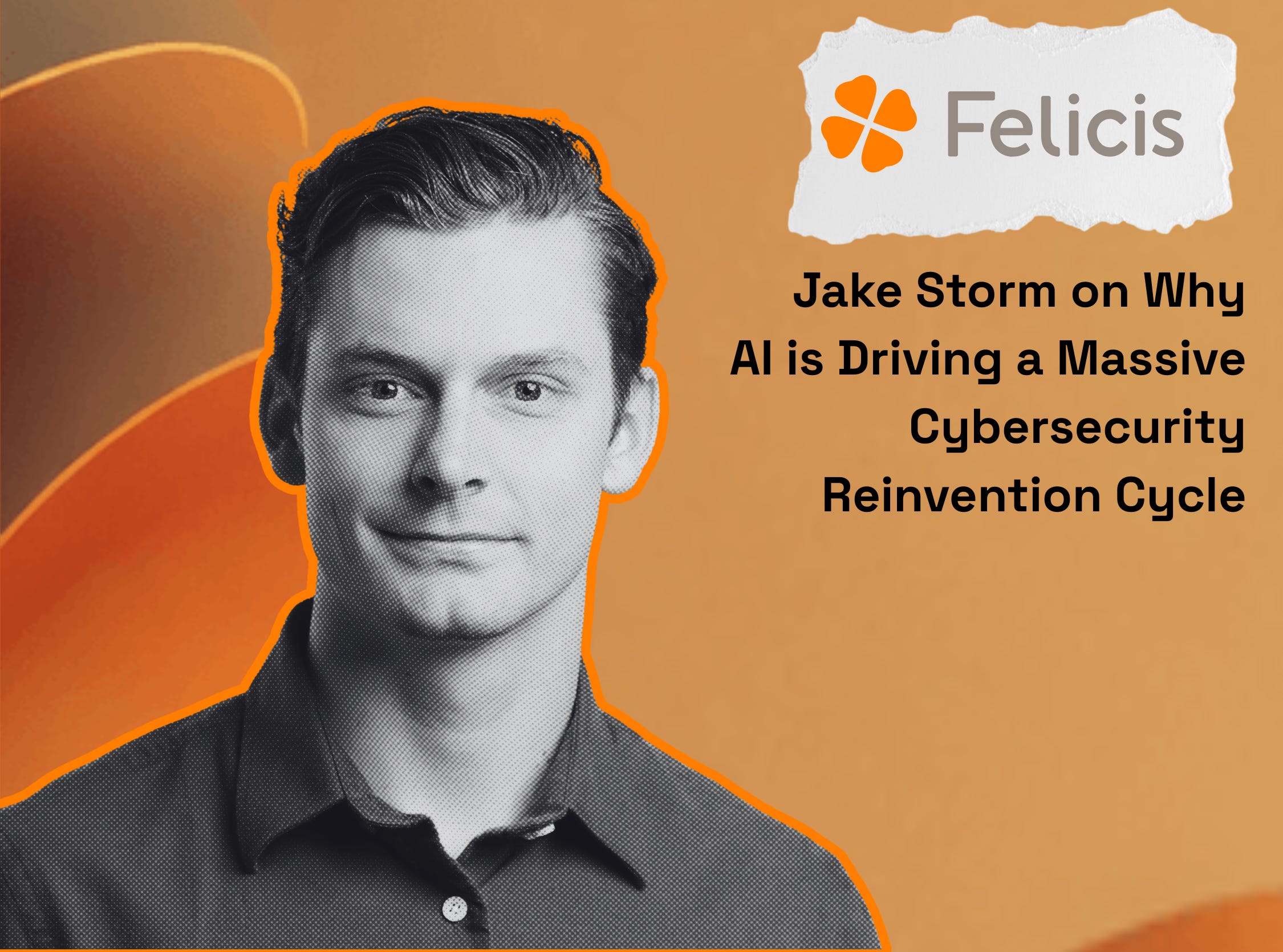
The cybersecurity landscape has reached what Jake Storm describes as “the worst of both worlds”. For an attacker, the cost to launch a strike is at an all-time low. Conversely, for the defender, the cost to protect an organization is only increasing.
This asymmetry is driven by our current transition into the AI era. While the cloud wave focused on a new storage layer, AI introduces non-deterministic agents; these are systems that act on a user’s behalf in ways that aren’t always predictable. Jake views this not just as a new challenge but as a total refresh of the cybersecurity stack. As he sees it, we are currently in the innovation age of AI, a period of exponential vulnerability growth that requires a fundamental shift toward proactive, automated prevention.
TL;DR
The Buyer Shift: Security spending is moving from IT departments to highly technical engineering teams who favor specialized depth over broad, shallower platforms.
Innovation vs. Optimization: We are in the innovation phase of AI where threats grow exponentially. This contrasts with the current optimization phase of the Cloud, where threats grow more linearly.
The Shift Left: The next generation of winners will move security earlier in the development process, preventing vulnerabilities during the code generation phase rather than scanning for errors after deployment.
Diminishing Services: AI is beginning to absorb the traditional cybersecurity services market.
About Felicis
Felicis is a venture capital firm highly focused on the early stage: 94% of the current portfolio investments are made at seed or series A. The firm leads or co-leads most of their investments (83%), and is among the top 8 VC firms with a track record of backing 8 mega-unicorns ($5B+ exits) at Seed, A, or B in the last decade. The firm’s track record includes early bets on industry-leading unicorns such as Adyen and Plaid, alongside high-growth innovators like Tines, Semgrep, Supabase, ConductorOne, Terra Security, and Observo.ai.
A core pillar of the Felicis strategy is investing in reinvention. They look for companies that don’t just add a feature but rethink an entire category for a new technological paradigm. In cybersecurity, this translates to a belief in a built-in refresh cycle that occurs every five to nine years.
Jake’s focus on cybersecurity is a direct execution of this refresh cycle thesis. He views the current AI wave as a more significant catalyst for security than the shift to the cloud was, making this the time to find the next decade’s foundational security companies.
About Jake Storm
Jake’s perspective is rooted in a childhood spent moving between various regions of the U.S. and Brazil. This early exposure to diverse cultures taught him that trust is built on finding commonalities, a trait that informs his relationship-driven approach to venture. Before joining Felicis, Jake focused his lens on enterprise software and security at IVP, Jefferies, Qualtrics, and Zuora.
For Jake, cybersecurity is a mission-critical function that offers the feeling of us against the world. He is drawn to the sector because it is one of the few areas where budgets are durable. He views the current talent shortage in security as a gap that can only be bridged through aggressive technological advancement.
He prioritizes seeing the present as clearly as possible rather than trying to read tea leaves about the future. He spends his time with practitioners and Chief Information Security Officers (CISOs), the executives responsible for an organization’s data and information security, to understand the ground truth of their daily operations. He believes extraordinary things happen at the convergence of hustle, focus, and humility.
Deep Dive into the Theses
Thesis 1: The Rise of the Technically Sophisticated Buyer
The Opportunity: There is a fundamental shift in who holds the checkbook for security tools. While the buyer may remain the same, the decision maker is moving from traditional IT departments to cybersecurity and engineering teams. These new decision makers are builders rather than more traditional administrators.
The Rationale: As technology becomes more complex, the technical barriers for practitioners have actually risen. For example, spinning up a simple S3 bucket (a public cloud storage service) requires managing 60 or 70 different configurations. To secure this, a lead needs to understand the deep technical implications of every toggle. Security analyst roles, which are often entry-level, are stalling as automation takes over; security engineer roles are the fastest-growing category in the market.
The Conversation: This shift creates a tension between platforms and best-of-breed solutions. While massive players like Palo Alto Networks are acquiring specialized startups like Dig Security to offer a fully-featured platform, Jake observes that sophisticated teams often reject these all-in-one platforms. They want the specific tool that solves a high-stakes problem with the most depth.
However, there is a risk in this trend. Many in venture tend to over-extrapolate how much of the market is actually sprinting toward these advanced tools. In reality, a large majority of the market is still in a crawl phase. Choosing best-of-breed tools requires a level of cybersecurity sophistication that most companies haven’t reached yet; for them, a stable platform is often the more secure, albeit less innovative, choice.
Thesis 2: AI as a Catalyst for Net-New and Reinvention
The Opportunity: AI will have a greater impact on security than the cloud because it demands two things simultaneously: the reinvention of existing tools and the creation of net-new categories.
The Rationale: Cloud computing was essentially an extension of on-premise storage. AI, however, introduces agents that are non-deterministic, meaning they can produce different outputs from the same input. This creates a magnitude of risk that traditional tools cannot handle. For instance, code generation tools can introduce subtle vulnerabilities that a standard code scanner might miss.
The CISO Perspective: This isn’t just an investor theory. When Felicis surveyed CISOs, the consensus was clear: they expect AI to have a far greater impact on security than the cloud ever did. They are currently grappling with how to wrap their heads around these non-deterministic workflows and the brand-new surface area of attack they introduce.
New Attack Vectors: Jake is looking for companies that address new threat vectors like prompt injections, where an attacker manipulates the input of an AI model to bypass security filters, and the evolution of phishing. In the past, phishing was easy to spot due to broken English or grammatical errors. Today, AI allows anyone to generate perfectly written, highly convincing attacks at no cost.
Thesis 3: Shifting Left toward Proactive Defense
The Opportunity: The industry is moving away from the reactive model of debugging toward a proactive model that prevents the bug from existing. This is often referred to as shifting left, or moving code quality protocols earlier into the development lifecycle.
The Rationale: In an era where AI-native attacks move at machine speed, organizations no longer have days or weeks to respond. The standard process currently involves releasing code, scanning it, finding a vulnerability, and creating a Jira ticket for an engineer to fix it later. This relies on too many man-hours and leaves a window of risk open. One hour spent on prevention is worth 15 hours of remediation after a breach.
The “Why Now”: We are roughly three years into the AI reinvention cycle. History shows that the winners of a new era typically emerge a few years after the initial technological shift. Jake points to companies like Corridor as a prime example. Instead of scanning code after it is written, Corridor provides a contextual model of a company’s entire codebase. As an AI agent writes new code, the tool can identify a business logic flaw in real-time before the code is ever deployed; this effectively moves the security barrier left, to the very start of the process.
Conviction and Skepticism
Areas of Skepticism: While some investors are building theses around quantum computing and its ability to break current encryption, Jake remains focused on the immediate compounding risks of today’s AI-driven attacks. He notes that Felicis is focused on “seeing the present as clearly as possible”.
Diminishing Services: Historically, about half of the cybersecurity market has been made up of services; human consultants performing tasks like penetration testing (simulated attacks to find gaps). Jake believes AI is rapidly absorbing this revenue. Companies like Tines (automation) and Terra (AI pen-testing) are replacing billable human hours with high-margin software. This isn’t a total collapse of the services industry; it is a reorganization where software takes over the repetitive, labor-heavy tasks.
Looking Ahead
The Next Frontier
Jake is closely watching the convergence of specialized line items. In the identity sector, the market has evolved from $2 billion companies like Ping Identity to $18 billion giants like Okta. He expects the next generation of identity companies to consolidate even more functionality, creating even larger market opportunities as disparate security needs reorganize into unified, AI-driven solutions.
Final Word
“Cybersecurity is fascinating because it’s a mission-critical function that requires the industry to reinvent itself with every shift. It’s one of the most exciting times ever to be a cyber investor because everything is up for grabs.”


 | A guest post by
|
 | A guest post by
|