



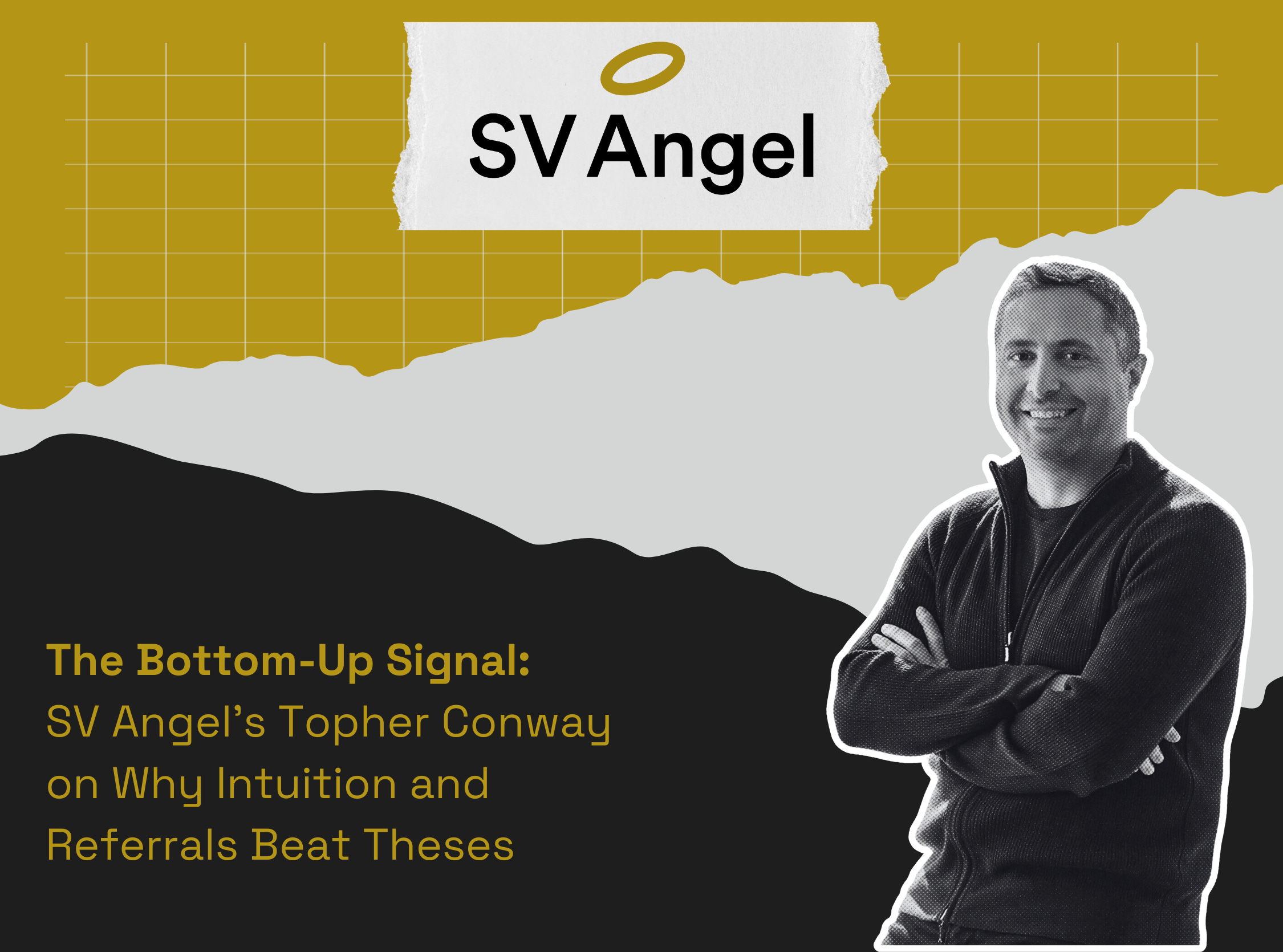
For SV Angel, one of the Bay Area’s most storied firms, success hasn’t come from chasing trends, but from letting the market reveal them.
Instead of trying to predict the future, they listen to it.
Topher Conway, a principal at the firm whose family’s angel investing history dates back to 1993, outlines a philosophy that is less about conviction and more about consolidation. SV Angel’s process is a relentless, high-volume search for pattern recognition, built entirely on a referral system. They do not chase trends; they wait for founders to bring them to their door, signaling a market shift from the ground up.
As Topher notes, their job is not to predict, but to be educated by the entrepreneurs who are spending 110% of their time solving one problem. This bottom-up approach allows them to spot emerging trends, such as the verticalization of AI happening now, not through an internal whitepaper but through the sheer volume of identical, unacquainted ideas flooding their pipeline.
Key Takeaways
Pattern Recognition Over Prediction: SV Angel is not thesis-driven. They identify macro trends by reviewing 40 to 70 referred companies weekly and looking for the same novel idea to appear repeatedly.
The Power of a Small Check: The firm maintains a small Seed fund of $40 million (their growth fund is $330 million) to enable small, checks that encourage collaboration with other VCs.
Intuition is Crucial: The core of their decision-making is a
“gut feeling” or “aha moment” with a founder, a lesson learned early, having made his first investment (Napster) at age 13.
Inflection Point Support: Portfolio management for their large network is scaled by focusing support only on crucial inflection points: early sales/business development, corporate development, and financing.
The Platform: Firm-Level Strategy
The Firm’s Identity
SV Angel’s current fund platform dates to 2009, but its founder-first philosophy has remained consistent for decades. Today the firm typically invests $150,000–$200,000 at the seed stage, backing roughly one new company per week. In recent years, SV Angel has also operated a growth fund to continue supporting select breakout companies beyond the seed stage. All investments are sourced exclusively through referrals from its highly curated 30-year network, reflecting a strategy focused on exceptional founders over specific industries.
SV Angel is focused on the “early stage of company formation” and has participated in funding some of the most iconic technology companies of the past two decades.
The Overarching Philosophy
The firm’s overarching philosophy is defined by alignment and collaboration. By maintaining a small seed fund size (around $40 million), SV Angel can insert small, flexible checks into funding rounds. This approach achieves three strategic goals:
Founder Differentiator: In a market with ballooning check sizes, their smaller, early investment helps them slot in easily.
Investor Collaboration: It keeps the firm non-combative with almost every other VC, fostering strong relationships and increasing their access to high-quality deal flow (referrals).
LP Returns: The belief is that smaller funds tend to generate better returns for Limited Partners.
Alignment
Topher’s focus on high-volume review and deep pattern recognition is a direct continuation and “institutionalization” of the firm’s original angel investing style. His work across both seed and growth funds aligns perfectly with the firm’s strategy of being a flexible, network-driven resource for founders at every stage of their development, from first check through growth financing.
The Navigator: Individual Thinking and Background
The Journey to the Thesis
Topher’s background in venture capital is almost a birthright, with his father starting the family’s investment journey in 1993. As the youngest of three, he was most exposed to the early-stage process. The pivotal moment that shaped his investment lens came at age 13 when his father sought his opinion on an early investment in Napster.
He describes the moment he first used the file-sharing service as an “aha moment.” It was a gut feeling that this was “amazing” and possible on the internet. This formative experience instilled a core belief in trusting one’s own visceral, emotional reaction to a new technology.
The “Why”
This personal experience in the late 90s drives his conviction today: Venture capital is a business of pattern recognition and gut instinct, not just spreadsheets. While the data is richer for growth-stage companies, he maintains that the fundamental question remains the same for both seed and growth investments: “Do I believe in the founders to go and build a massive company?”
Investment Philosophy
Topher’s investment philosophy is centered on being a high-leverage, low-time-commitment resource for founders. The firm is highly concentrated, with approximately 75% of its portfolio in the Bay Area, and 20% in New York, focusing largely on US-based software businesses.
They don’t aim to be in the boardroom or lead a financing round. Instead, they leverage their expanding, decades-old network on behalf of the founder for maximum impact with minimum time commitment.
The Core: Deep Dive into Investment Theses
Thesis 1: The Bottom-Up Trend Detector
The “What” (The Opportunity)
The true opportunity lies not in being the first to announce a thesis, but in having the best signal-to-noise ratio for identifying a trend. SV Angel’s referral system and high review volume (40-70 companies a week) turn the firm itself into a market indicator. They are positioned to see a trend as it is forming across multiple, unacquainted founding teams.
The “Why Now” (The Rationale)
In a market saturated with venture capital, founders are the true innovators. Today, founders are exploring the frontiers of AI technology. The rationale for this approach is that the founders who are fully immersed in solving a specific problem are the best educators on identifying underlying market and technological shifts that make their solution timely.
The “Conversation” (Nuance and Debate)
The internal debate at SV Angel is not whether a trend is happening. Instead, the focus is on how many companies they should index in that space. Topher points to historical instances, such as delivery services (DoorDash, Instacart, etc.), where they purposefully invested in several competing firms to ensure exposure to a significant market shift. The art is determining the size of the overall market and the number of viable competing approaches.
The “Winning Profile” (What They Look For)
They look for founders who can generate that initial “aha moment.” In the current market, this translates to software founders who are already showcasing the verticalization of AI: the new markets and applications that are unlocking as the core technology continues to evolve and develop.
Thesis 2: The Network as Scalable Support
The “What” (The Opportunity)
For a firm with hundreds of companies in its portfolio, the opportunity is to transform that portfolio into a massive, defensible asset (network support). They capitalize on the collective experience of this network to provide high-leverage support for founders.
The “Why Now” (The Rationale)
The growth of the overall venture ecosystem has made fundraising an easier problem to solve, but the challenge of scaling a company remains. The network is most valuable in solving tactical, company-critical problems that a founder can’t solve alone, such as early sales, attracting the best talent, or finding business development opportunities.
The “Conversation” (Nuance and Debate)
The key debate is how to maintain high-quality support without getting dragged into the operational minutiae. The firm manages this by strictly focusing on inflection points: business development (early sales and introductions), corporate development (M&A discussions), and financings.
The “Winning Profile” (What They Look For)
A winning company profile is one that can articulate a need that the SV Angel network can easily solve. For recent investments, this is often the need for early sales, making introductions to older, more established portfolio companies to secure initial crucial customers.
Strategic Focus and Pattern Recognition
Risk and Regulation
The firm’s highly concentrated geographic focus (75% in the Bay Area) and product focus (US-based software businesses) inherently limits exposure to certain international market risks or highly specialized, regulated sectors. The firm’s primary focus is on how they can leverage their network to solve problems that arise, such as connecting founders with immigration counsel for an employee.
Second-Order Effects
Topher notes that their high-volume deal review and pattern-recognition process allows them to see second-order effects in real-time. By observing the immediate verticalization that is happening within AI, they are tracking the consequences of the core technology and where new opportunities are being unlocked.
Looking Ahead
Topher suggests the next frontier is the verticalization of AI and the new markets that are being unlocked as the technology continues to evolve. While they are currently investing in this space, the continuous evolution suggests a rapidly shifting landscape where the new applications are still emerging.

Based on his long-standing view on the importance of the founding team, the provocative question Topher might wish to debate is:
“In a world where technology and capital are increasingly commoditized, how much of a company’s eventual success still comes down to the individual conviction and sheer grit of the founder, and not the underlying market trend?”
More from Uncovered Media

