



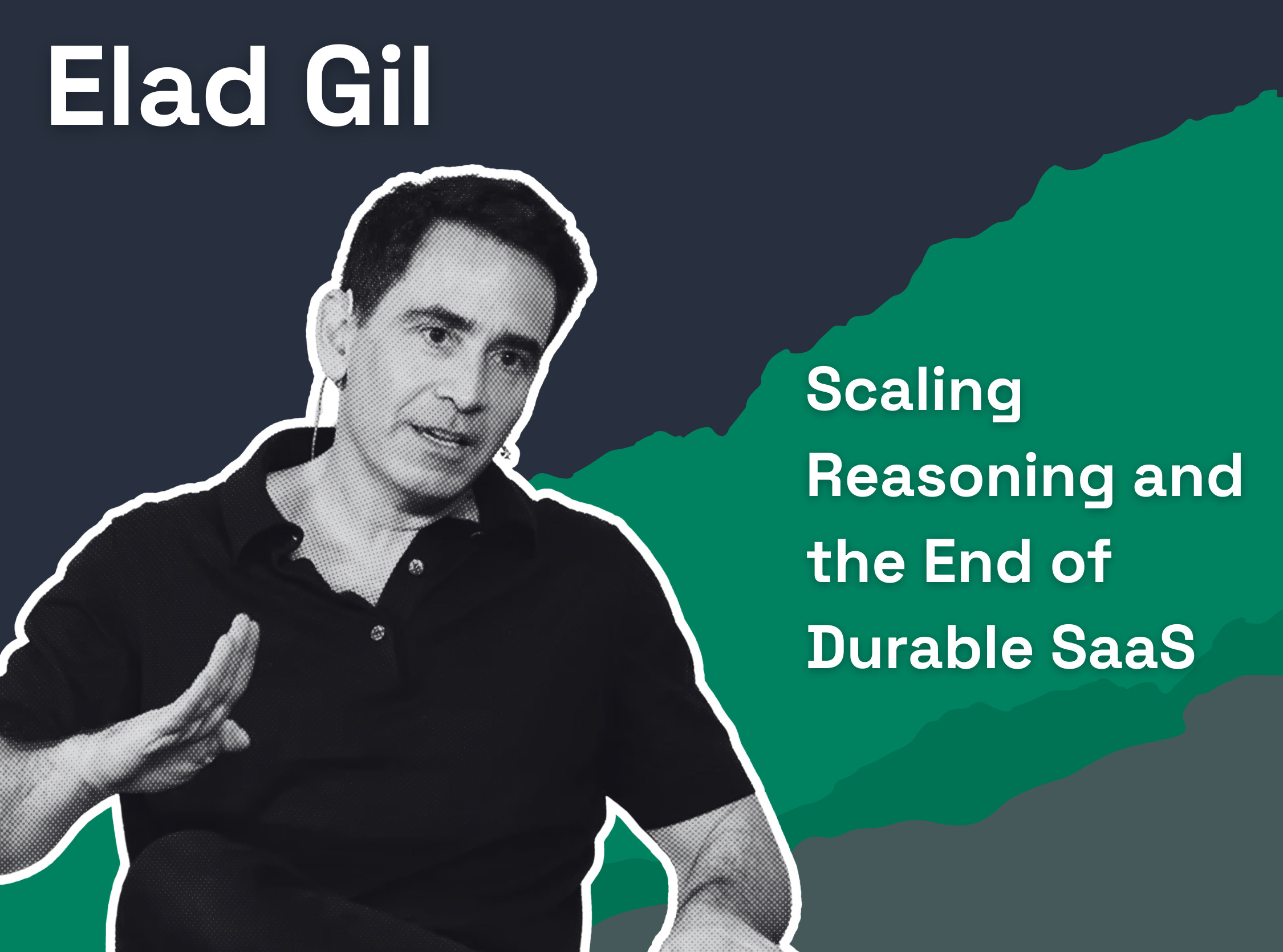
As a solo GP managing over $1 billion, Elad Gil operates with a density of hits (including Stripe, Airbnb, Coinbase, and Notion) that most multi-partner firms would envy. In his recent conversations on the No Priors Podcast, Elad, along with his podcast co-host Sarah Guo, challenges the traditional wisdom that heavily regulated industries are technological laggards. Instead, he argues that medicine and law are the actual vanguard of the AI revolution, driven by a desperate need to scale expert reasoning.
TL;DR
Professional Fields are the Real Early Adopters of AI: Contrary to historical trends, law and medicine are rapidly adopting AI because they are text-heavy and reasoning-constrained.
Software Becoming as Ephemeral as Media: The era of durable SaaS is being replaced by software that behaves like media; it is cheaply generated, transient, and personalized on the fly through “vibe coding.”
The Reasoning Revolution: Reasoning models are transforming every industry from biology to robotics by moving beyond simple text-in, text-out to complex logic trees.
Organizational Over Individual Productivity: The next frontier isn’t just making a lawyer faster; it’s building collaborative AI systems that transform how entire firms operate at scale.
Elad Gil
Elad operates one of the largest solo GP venture funds ever built, raising over $1 billion while maintaining a single-partner structure. It’s also reported that he’s actively raising another fund with a $3B target. He has an unusually dense hit rate across breakout companies like Airbnb, Stripe, Coinbase, Figma, and Notion. He treats his content creation as a key strategic advantage; he turns his public insights into a roadmap that founders use to build their own companies, creating a scalable portfolio-support platform.
Elad’s model is built on high conviction and the ability to move with the speed and agility required to navigate the volatile AI landscape. He prioritizes founders who are focused on foundational shifts in capability: those who look past immediate market limitations to build toward the future of AGI. By operating alone, he avoids the friction of large committees; this allows him to learn and iterate alongside the technology.
His focus on cognitive infrastructure aligns with his background as a researcher and operator. Whether it’s investing in foundation labs like Mistral or vertical applications like Harvey, Elad is betting on a fundamental shift in software business models. The transition isn’t merely about faster tools; it’s about a total transition from selling software access to selling autonomous labor. He argues that we are moving away from selling “seats” to selling “units of cognition.” Consequently, enterprises will increasingly pay for the actual outcome or the completion of a task rather than just the tool used to perform it.
Individual Thinking & Background
Elad Gil’s perspective is uniquely shaped by a career spent at the intersection of deep research and hyper-scale operations. With a PhD from MIT in biology and degrees in math, he has seen “existence proofs” of radical change in biology that he now applies to machine learning.
His journey through Google and Twitter gave him a front-row seat to how platforms capture value during technology shifts. He was working on AI and mobile at Google long before they were mainstream; furthermore, he ran AI-centric product organizations at Twitter. This dual lens, the scientist’s rigor and the operator’s tactical sense, informed his “High Growth Handbook,” which founders now use as a playbook for scaling. Elad operates on a core scaling principle: that once a breakthrough occurs, growth becomes a function of scale rather than reinventing the wheel. His conviction in AI is based on a decade of observing scaling laws and the intuition that “anytime you make that initial breakthrough, you can usually just scale and things keep working.”
Deep Dive into Investment Theses
These insights are drawn from Elad’s conversations on No Priors with co-host Sarah Guo and guest Gabe Pereyra, co-founder of Harvey.
Thesis 1: The Professional Field Acceleration
The Opportunity: Traditional venture wisdom holds that law, medicine, and government are “laggards” that take a decade to adopt new tech. Elad’s thesis is that AI has inverted this. Because these fields are text-heavy and reasoning-constrained, they are actually the early adopters of the current AI wave.
The Rationale: In these industries, the primary input is expert time. AI doesn’t just offer marginal efficiency; it allows for an immediate increase in the “volume of expertise.” Elad points to the rapid deployment of systems like “GenAI.mil,” which reached 1 million users in 30 days; this is a speed unheard of for government software. The technology has finally evolved to meet the specific, complex logic required for high-stakes professional work.

The Conversation: The debate centers on the “future of the firm.” If AI augments or replaces the work of junior associates, how do law or consulting firms train the next generation of partners? Elad notes that while AI can explain a merger agreement’s structure, the high-level strategy and client judgment remain human domains. He acknowledges the risk; “shrinking the bench raises questions” about where the next decade of experts will come from.
The Winning Profile: Elad looks for companies that move from individual productivity tools to “organizational productivity” platforms. The winner isn’t a “wrapper” around an LLM; it’s a system that hooks into billing, governance, and data rooms to power the team’s end-to-end operations.
Thesis 2: Software Becoming as Ephemeral as Media (The Vibe Coding Shift)
The Opportunity: Elad argues we are moving away from an era where software is a durable good, something you build once and rent via SaaS, to an era where software is becoming as ephemeral as media; it is something more like a “content stream” that is rendered on the fly.
The Rationale: This is driven by “vibe coding,” where product managers skip the months-long requirements and mock-up process. Instead, they “vibe” a functional UI into existence in an afternoon. If an AI can generate custom logic for a specific task in seconds, the software begins to act more like a content stream than a static tool; consequently, the traditional “moat” of SaaS (the code itself) evaporates.
The Conversation: This shift threatens the “pure-play” software revenue model. If anyone can generate a tool for a specific task on the fly, why pay a monthly subscription for it? Elad posits that while “products” (simple tools) are replaceable, only “platforms” (where the data and collaborative tissue live) remain durable.
The Winning Profile: He looks for applications that focus on “proactive integration”: systems that extract user intent and utilize the full context of a firm’s data to complete tasks before the user even asks. The goal is to move beyond the chat box and into “proactive AI” that knows what the organization knows and acts on it.
Conviction and Skepticism
Areas of Skepticism: Elad sees two major red flags for AI tools:
Just repackaging AI: He avoids companies that merely reformat data from a language model. If the base AI gets smarter and replaces your product, you have no competitive moat.
Changing too much at once: He warns against forcing a massive redesign of how people work. The best tools fit seamlessly into existing processes rather than trying to blow them up entirely.
Risk and Regulation: Despite being a “future-forward optimist,” Elad is vocal about the risks of drone-based warfare and the politicization of AI. He expects AI to become a major point of discussion in upcoming elections, with public sentiment potentially turning against the technology as it becomes more transformative.
Looking Ahead
Elad is looking beyond language models to “foundation models for everything”: physics, biology, materials science, and simulation. He predicts that “reasoning systems” will soon revolutionize industries like drug discovery by designing full-length antibodies zero-shot on a computer.
The Final Word: “AI today is like a really eager intern—sometimes it knocks it out of the park, and sometimes the work is bad. Over time, it’ll get better.” (conversation with Lareina Yee at McKinsey)
More from Uncovered Media


