



We recently dug into the thinking of Pat Grady and Sonya Huang, key partners at Sequoia Capital and leaders in the firm’s AI practice. In the world of venture, Sequoia has been a central character in the AI story, most notably as an early, pivotal backer of OpenAI.
But what’s compelling isn’t a single thesis. It’s the evolution of one. Starting in 2022, Pat, Sonya, and the Sequoia team have publicly mapped their thinking on Generative AI, almost like an annual report on the state of the revolution.
Their journey tracks the market’s own whiplash: from the initial “better, faster, cheaper” hype of 2022, to a sober “prove your value” correction in 2023, to the rise of “agentic reasoning” in 2024.
Now, they are articulating the next great shift, moving beyond simple text or images. They call it “AI Synesthesia”—a new era where models are natively multimodal, able to connect different types of data (text, images, sound) as if they were all the same format. This isn’t just a technical upgrade; they argue it’s a fundamental “shift in the cognitive interface” between humans and machines, one that finally unlocks intelligence trapped in the wrong modality.
TL;DR: Theses and Key Quotes
The “AI Synesthesia” Era is Here: The next frontier is not just AI that handles text, image, code, and audio, but AI that thinks in a unified way across all of them. It’s about “unlocking intelligence that’s been latent, unexpressed, or trapped in the wrong modality”.
From Hype to Utility: The AI market has rapidly matured. “Act 1” was the initial hype. “Act 2” was the correction, focusing on solving “human problems end-to-end” and proving value.
The Rise of “Thinking Slow”: The latest shift is to an “Agentic Reasoning Era”. This moves AI from “thinking fast” (instant pre-trained responses) to “thinking slow” (not just matching patterns, like a simple chatbot, but is actively “thinking”) to solve complex, real-world problems.
Moats are Workflows, Not Just Data: Sequoia’s initial 2022 thesis on “data flywheels” was corrected by 2023. They observed that the most durable moats are not in the data itself, but in “customers” and embedding AI into “workflows and user networks”.
Raising the Floor and the Ceiling: The ultimate goal of AI Synesthesia is to “raise both the floor and ceiling of human capability”. The floor rises as specialized skills (like coding) become accessible to all; the ceiling rises as experts gain new ways to express complex ideas.
The Platform: Sequoia Capital
To understand this thesis, you have to understand the platform it’s invested from. Founded in 1972 by Don Valentine, Sequoia Capital is arguably the defining venture firm of the modern technology era. Its portfolio reads like a history of tech itself, from Apple and Atari to Google, Cisco, PayPal, Nvidia, Airbnb, Stripe, and YouTube.
The firm’s philosophy is famously captured in its tagline: “We help the daring build legendary companies, from idea to IPO and beyond”. This isn’t just marketing copy; it defines their strategy.
Founder-Obsessed: Sequoia invests in people first, focusing on the founder’s vision and culture.
Long-Term Partners: The firm sees itself as a “partner for the long term,” famously forbidding the use of terms like “deal” or “exit” internally.
Team Sport: Grady and other partners emphasize that VC at Sequoia is a “team sport,” not a game of individual showmanship.
Mission-Driven LPs: A core, motivating part of Sequoia’s identity is that it invests primarily on behalf of nonprofits, universities, and foundations.
As key partners in the firm’s growth-stage and AI investments (co-leading the OpenAI investment), Grady and Huang are perfectly aligned with this mandate: find the next “daring” founder who will build a “legendary” company to define the next 50 years.
The Navigators: How Grady and Huang Think
As the co-authors of Sequoia’s key AI theses and co-hosts of the “Training Data” podcast, Pat Grady and Sonya Huang have become public-facing navigators for the firm’s AI strategy.
As a self-described “Silicon Valley kid at heart” and the daughter of immigrant engineers, Sonya Huang’s perspective was shaped by growing up in the “gravity well of innovation” of the 1990s. Her technical background, which includes an AB in Economics with minors in Computer Science and Statistics/Machine Learning from Princeton, gives her a deeply technical lens, stating, “I’m much more comfortable reading a technical paper or talking to a researcher than going to an industry conference”.
Grady’s background, for instance, is not typical Silicon Valley. He moved from construction jobs in high school to a high-volume inside sales role—making “50 dials a day”—before joining Sequoia in 2007. This experience informs a deep, personal connection to Sequoia’s mission. He notes that his own scholarship to Boston College was funded, in part, by proceeds from the very endowments Sequoia now invests for.
“If we screw up, people lose out on scholarships and cancer research,” Grady has said. “Now that’s motivation”.
This drives the team’s investment philosophy, which believes “culture is everything”. They view founders as the “heroes” of the startup journey and Sequoia’s role as that of a long-term, supportive partner on that “epic journey”. This view is critical to understanding why their theses aren’t just market-timing, but attempts to map long-term, tectonic shifts.
The Core: The Evolution of an AI Thesis
Grady, Huang, and the Sequoia team didn’t just publish one thesis; they’ve been publishing an evolving roadmap. This timeline shows how their thinking has tracked the industry’s own maturation.
2022 Thesis: “Generative AI: A Creative New World”
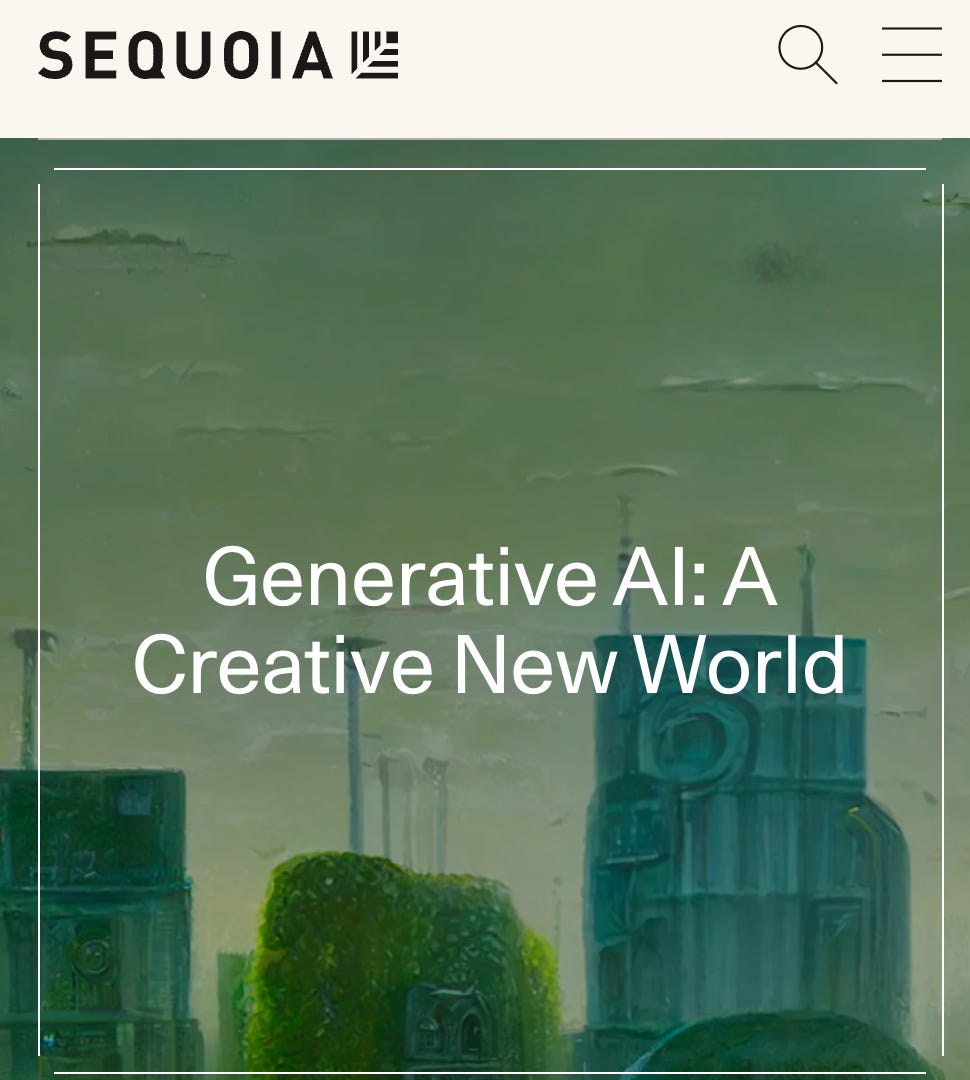
The “What” (The Opportunity): This was the foundational “hyperscale” thesis. It declared GenAI a profound platform shift that would empower “billions” of knowledge and creative workers. The focus was on making original work “better, faster, and cheaper”.
The “Why Now”: A combination of cheaper compute and new techniques (like diffusion models) was unlocking a “creative new world” across text, code, images, and soon video and 3D.
The Water Cooler: This was the shot heard ‘round the Valley—the moment a top-tier firm declared GenAI was not a toy, but the next major wave of computing.
2023 Thesis: “Generative AI’s Act Two”

The “What” (The Opportunity): After the “Cambrian explosion” of “Act 1,” the market needed to mature. “Act 2,” they argued, would be defined “from the customer-back”. The focus shifted from models as the product to models as a piece of a full-stack solution that solves “human problems end-to-end”.
The “Why Now”: The initial hype led to poor retention. GenAI’s biggest problem was no longer discovery; it was “proving value”.
The Water Cooler (The Correction): This was a critical update. The team explicitly revisited their 2022 thesis and stated that the real, durable moats were not just “data flywheels.” Instead, moats were being built in “customers” and, more specifically, in “workflows and user networks”. This is where companies like Harvey (which Grady led the investment in) thrive: by deeply embedding AI into the specific workflow of a specific industry.
2024 Thesis: “Generative AI’s Act o1”

The “What” (The Opportunity): This thesis, titled “Act o1”), declared the “Agentic Reasoning Era”. As the foundational layer consolidated around a few scaled players (OpenAI, Anthropic, Google, etc.), the new opportunity is in reasoning.
The “Why Now”: The shift is from AI “thinking fast” (pre-trained, instant pattern-matching) to “thinking slow” (using compute at inference time, not just delivering a pre-cooked answer learned during training, for deliberate reasoning and problem-solving).
The Water Cooler: General-purpose models are not enough. The “messy real world” requires customly designed, cognitive architectures and domain-specific reasoning. This is the layer where startups can build massive, defensible businesses on top of the big platforms.
2025 Thesis: “On AI Synesthesia”

This brings us to today. “On AI Synesthesia” is the culmination of the previous three theses. It takes the consolidated models (Act o1) and the need for end-to-end solutions (Act Two) and defines the new human-computer interface that will power them.
The “What” (The Opportunity): The thesis identifies the shift to natively multimodal models. This is not about “bolting on” an image generator to a text-based LLM. It’s about models that are built from the ground up to understand text, image, code, video, and audio in a “unified latent space”. This unified approach makes the creative process “more controllable” and allows generation to happen “all together” rather than in separate, loosely-coupled systems. The team argues this is a profound “shift in the cognitive interface” between people and computers.
The “Why Now” (The Rationale): For most of computing history, intelligence flowed through a “narrow channel: text in, text out”. This created a power dynamic: if you were a good writer or coder, you could command the machine. But, as the article notes, “intelligence isn’t limited to words. Some think visually, rhythmically or spatially”. This new class of multimodal AI finally “bridges these gaps” and “unlocks intelligence that’s been latent, unexpressed, or trapped in the wrong modality”.
The “Water Cooler” (Nuance and Debate): This is AI’s “synesthesia moment,” named for the neurological trait where one sensory experience (like hearing a note) triggers another (like seeing a color). The team points to composer Alexander Scriabin, who “experienced music as color” and could “fluently transition across sensory modalities”. “What was once rare neurological wiring,” the thesis states, “is now becoming our shared digital capability”. In this new era, “creativity becomes translation”. An idea is no longer trapped in the mind of a person who can’t code, draw, or write; it can be “fluidly transferable”.
The Winning Profile (What They Look For): The team is looking for companies that build for this new “mental operating system”. These winners won’t just be tools; they will be partners that “raise both the floor and ceiling of human capability”.
Raising the Floor: This means specialized skills become accessible to everyone. “Visual thinkers can speak in paragraphs. Coders can sketch in pixels. Writers can prototype products”.
Raising the Ceiling: This means experts are given new superpowers. “The barriers between disciplines, roles and modes of thought begin to dissolve”. The winning companies will be those that understand this fundamental shift: “Your strengths are no longer limited to the format you were trained in. Your ideas are no longer trapped in the mode you happen to be best at”.
From Hype to Integration: A Playbook for a High-Speed Market
The nearly four-year journey mapped out by Grady, Huang, and the Sequoia team is a playbook in itself. It demonstrates a thesis that is not static, but a living, breathing framework designed to adapt at the same speed as the technology it tracks.
In 2022, the call was about potential—a “creative new world” of “better, faster, cheaper”. But by 2023, the market delivered a harsh lesson in retention, proving that hype doesn’t pay the bills. Sequoia adapted its thesis publicly, shifting the focus from novelty to value. The moat, they corrected, wasn’t the model; it was the “workflow” and solving “human problems end-to-end”.
This pragmatism paved the way for the next layers of opportunity. The 2024 “Agentic Reasoning” thesis identified the “thinking slow” layer not as a consolidated commodity, but as the critical engine for real-world problem-solving. And 2025’s “Synesthesia” is the human-centric payoff: a new, fluid interface that unlocks all forms of intelligence, not just the verbal ones.
What this evolution shows is a move from what (the generative model) to how (the reasoning agent) to who (the human user, in all their multimodal intelligence). In an industry where change is measured in months, not years, the Sequoia team’s public roadmap suggests the most durable investment strategy is one of relentless adaptation, a willingness to correct course, and a constant search for the human value inside the machine.
More from Uncovered Media

