




Venture capital tends to cluster around visible pain. Founders build for the problems they know, investors pattern-match around the markets they recognize, and entire categories of work remain untouched simply because they sit too far outside the software imagination of San Francisco and New York.
Eric Theis thinks that is precisely where some of the best AI opportunities now live.
At Bling Capital, the seed firm known for backing companies at the earliest stages and helping them scale product-market fit, Eric has been drawn to a class of businesses that rarely make it into the glossy narrative of startup innovation: third-party service providers, outsourced operators, and managed-service firms handling complicated but non-core work for the rest of the economy. These are not glamorous markets. They are the oddball corners. International subsidiary compliance. Down-market credit servicing. IT management. Revenue cycle operations. Patient access. The kinds of workflows that are essential, expensive, exception-heavy, and historically too messy to fully automate.
For years, software could handle maybe 95 percent of the task. The last 5 percent, the strange edge cases, the one-off exceptions, the judgment calls, kept humans firmly in the loop. That last layer mattered more than it seemed. It is what turned software into a tool rather than a replacement. It is what created armies of people managing exceptions behind the scenes. And it is what left billions of dollars of labor-heavy infrastructure largely intact.
Eric’s view is that AI changes that equation. Not everywhere, and not cleanly, but enough to make a new category of company viable: startups that do not merely sell software into services businesses, but increasingly sell a better outcome itself.
TL;DR
The core thesis: AI is opening a path to automate neglected, exception-heavy workflows that have historically lived inside BPOs, MSPs, and service-heavy infrastructure businesses.
The real unlock: Previous software could not reliably handle the last layer of weird edge cases. AI can increasingly manage that complexity from the start.
Where to look: Markets that are critical but unglamorous, labor-intensive, geographically or culturally distant from tech hubs, and plagued by inconsistent delivery.
What winning looks like: The best companies may not sell seats or tools. They may sell the completed task, deliver higher more consistent quality, and capture higher take rates as a result.
What could go wrong: If enterprises build more in-house than expected, if margins collapse through commoditization, or if trust-heavy human relationships remain resistant to automation, the thesis weakens.
The Last 5 Percent Is Where the Opportunity Lives
One of the most useful ideas in Eric’s framing is that the barrier to automation was never the obvious part of the workflow. It was the strange part.
His perspective is shaped in part by time at Flexport, where he saw how fast-growing businesses can become trapped by operational complexity. The software could handle a great deal, but not everything. The result was a growing human layer built to catch exceptions and keep things moving. Over time, that creates what he describes as a kind of spaghetti process: manual workarounds, bespoke fixes, and operational logic scattered across people rather than encoded cleanly into the product.
That experience matters because it leads to a sharper definition of what AI may actually change. The promise is not simply that models are more intelligent. It is that founders can now attempt an end-to-end MVP in categories where the edge cases used to make that impossible or at least deeply impractical.
In previous generations of software, companies often started by filling the gaps with humans and hoped they would automate later. Many never caught up. The business scaled faster than the system. AI introduces a different possibility: start with a product that can absorb more of the weirdness from day one, then add humans only where absolutely necessary rather than building the company around them.
That is “why now” in its clearest form. The technology is getting good enough to handle more of the exceptions that used to break the model.
The Most Interesting Markets Are Often the Ones Tech Barely Sees
Eric keeps returning to a particular type of market. These are not categories founded by people solving their own consumer pain point. They are markets that sit outside the lived experience of most venture-backed founders.
He describes them as “neglected workflows in parts of the market that are not close to San Francisco or New York.” That line is more than geographic. It points to a deeper bias in startup formation itself. Founders tend to attack problems they personally encounter. That leaves a long tail of operationally important work untouched, especially in industries that were offshored, fragmented, or long ago dismissed as boring service categories.
Many of these workflows already have providers. That is the point. There are BPOs, MSPs, accounting firms, call centers, implementation partners, and specialty operators handling them today. But the persistence of those providers often signals less that the problem is solved and more that software has not yet been good enough to displace the labor. Eric is drawn to workflows that are essential but not central to the customer’s identity, categories where human-heavy service providers have accumulated complexity and mixed-quality delivery rather than product love, where incumbents have little economic incentive to invest in R&D, and where the market is large enough to matter even if it never looked like a classic venture category. These are not tiny curiosities. They are often deeply embedded pieces of economic infrastructure where success depends on “which person you happen to get”.
The Best AI Businesses Here Sell Better Outcomes, Not Tools
A central question in this category is whether startups should sell software into the existing service layer or replace that service layer outright.
Eric thinks both approaches can work, but his preference is clear. The stronger business is often the one that owns more of the workflow and delivers complete high-quality outcomes.
That distinction sounds semantic, but it changes the economics of the company.
A tool that helps an accountant move faster still leaves the accountant at the center of the transaction. The output quality depends highly on which accountant uses the tool. A system that delivers the finished compliance work begins to look less like SaaS and more like labor automation. It can justify higher pricing because it is not just improving productivity. It is taking responsibility for the task. And doing a consistently better job.
This is part of a broader shift that shows up repeatedly in AI investing right now. The value is moving away from access to software and toward completed work. Not software as a seat. Software as consistent execution.
Eric sees that dynamic across categories. In credit servicing, the appeal is not merely better yields, but an AI-first system that is consistently compliant without humans by default. In the healthcare revenue cycle, the prize is not just better visibility but the ability to handle the intelligence and actions required to navigate a deeply adversarial administrative process. In IT service management or international tax infrastructure, the opportunity is not another dashboard. It is a more vertically integrated system that can absorb the operational burden of managing a low-quality outsourced provider.
The company captures more value because it removes the volatility of labor.
Why the Incumbents May Not Be the Real Threat
One reason this thesis is compelling is that many incumbents are not simply slow-moving software companies. They are service organizations that neglected these workflows in the first place.
That creates a different kind of opening.
If a category is too small, too messy, too down-market, or too operationally annoying for the incumbent to prioritize, then the startup is not competing against a well-funded roadmap. It is competing against indifference. That is a much better setup.
Eric is explicit that some incumbents will attempt automation, especially in more upmarket segments. But in many of the markets he is drawn to, the economics have already signaled that this work is not strategically important enough to merit serious internal investment. If it was not worth staffing properly, it probably was not worth rebuilding from scratch either.
This is especially true in the more culturally distant corners of the economy, the places where startup founders and coastal investors have the least native exposure. The opportunities may be discoverable from the coasts, but they are often not legible there at first glance.
Healthcare as the Extreme Version of the Thesis
Healthcare appears in the conversation as both an example and an escalation.
Eric does not present a single sweeping thesis for all of healthcare. Instead, he points to a system full of data complexity, regulation, edge cases, adversarial incentives, and administrative labor. That makes it fertile ground for the same AI logic, though with higher barriers and slower adoption cycles.
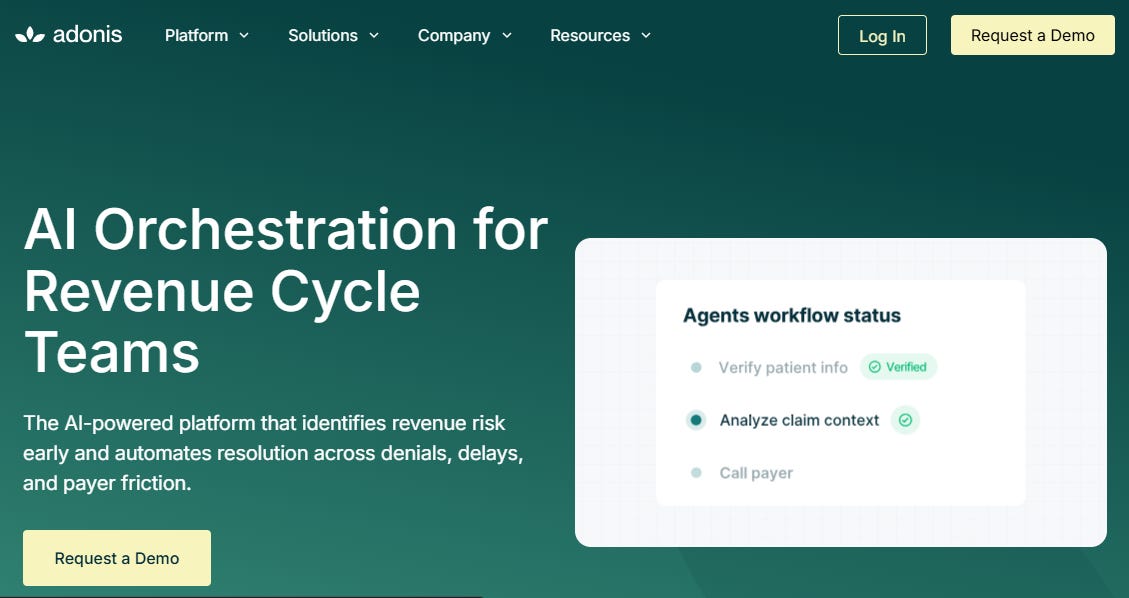
Bling has already made a revenue cycle management bet in Adonis. The significance there is not just that the revenue cycle is large. It is that it sits inside a system where enormous amounts of value are trapped in administrative combat between providers and payers. If AI can manage more of the intelligence, action-taking, and exception handling in that process, then the company begins to look meaningfully more powerful than a conventional software layer.
He also points to adjacent categories like patient access and hub operations in pharma, areas where huge budgets are already spent helping people navigate systems that were made operationally difficult on purpose. In those markets, AI may not remove complexity so much as become the new weapon for dealing with it.
What makes healthcare especially interesting is that it shows both the potential and the limits of the thesis. In some areas, like enterprise health systems, the barriers to entry are enormous. Procurement is slow, compliance is intense, and new AI vendors face committee-heavy buying processes. In other areas, like dental, there may be room to rethink the model itself.
His example of Wally is telling. Dental practices are often organized around the economics of surgery and equipment payback. Wally’s bet is that software and a different operating model can simplify care around prevention and non-surgical treatments. It is not AI in the science-fiction sense. It is AI and software making a different business design possible.

That is an important nuance. Sometimes the opportunity is not replacing labor in the existing system. It is building a cleaner system because software can finally support it.
Where Durable Advantage May Come From Now
One of the more interesting parts of the conversation comes late, when Eric acknowledges there are real unknowns around defensibility in the AI era.
Historical durable advantages may matter less than they used to. Integrations, once a genuine advantage, are easier to build. Some marketplace dynamics may weaken as agents make it easier to navigate around aggregators. Scale alone may not defend margins the way it once did.
That uncertainty matters because these businesses will need staying power somewhere.
Eric’s answer, or at least his directional instinct, is that the real advantage increasingly lives in the labor automation itself. If a company finds a network effect in owning a workflow for many related businesses, is the “just use it” trusted provider for a full category, and perhaps owns the payment rails or operational system of record, it becomes more than a software vendor. It abstracts away the pain entirely, and the customers stop thinking about replacements.
That is more durable than yet another feature set. But it is still a live question. He is unusually open about the fact that some of these assumptions may prove wrong.
Where the Thesis Could Break
Eric does not describe this as inevitable. He gives at least three reasons it may not play out as expected.
The first is enterprise behavior. If large organizations lean further toward building in-house rather than buying specialized solutions, then many of these startups may struggle to become core vendors.
The second is margin compression. AI may make certain forms of service work more efficient without creating enough differentiation for startups to capture durable economics.
The third is relational. Some service businesses are not just operationally complex. They are human-trust businesses. If the customer experience still depends on a person, or if buyers simply do not trust autonomous systems in emotionally or financially sensitive moments, then the market may resist full automation longer than expected.
Those caveats strengthen the thesis rather than weaken it. They make clear that this is not a generic AI-for-services enthusiasm. It is a much more specific bet about which kinds of complexity are now tractable and which kinds of trust can actually be transferred to software.
What Eric Is Really Betting On
At the deepest level, this is not a thesis about software efficiency. It is a thesis about where the market has quietly tolerated labor because software previously failed.
That is why the oddball framing works.
These markets were not untouched because they were too small. Many are large. They were not untouched because they were unimportant. They are often mission-critical. They were untouched because they were too strange, too fragmented, had too-low margins, too low-status, too geographically distant, or too exception-heavy to fit the standard startup script.
AI makes those categories newly interesting not because it makes them sexy, but because it makes them buildable.
And for investors willing to spend time in the parts of the economy the venture market usually ignores, that may be where a meaningful share of the next wave of alpha lives.
More from Uncovered Media


